
Article · Perimenopause
Perimenopause: the switch, not the slope.
What actually happens to a woman’s skin in perimenopause — and why she is right when she says it happened overnight.

“I woke up and looked in the mirror and my face had fallen off.”
“My cheeks have inconveniently relocated to my jowls.”
“Overnight I developed hooded eyes and dull, floppy skin.”
“I caught myself in a shop window and suddenly realised I had become my mother.”
“I look like I feel. Sad, angry and tired.”
“I look in the mirror and I don’t recognise myself. And not in a good way.”
Over thirty-five years as a GP and nearly twenty as a cosmetic physician, I have listened to thousands of women trying to describe what they are seeing when they realise, somewhere around their forties, that something has changed.
The descriptions vary. One thing almost never does. They tell me it happened overnight.
The obvious explanation, which is also true
The late thirties and early forties are a brutal stretch, and I have watched it from every angle — as a doctor, as a friend, as a partner.
The mental intensity and sleep deprivation of raising small children. Rising responsibility and workload at exactly the point in a career when the demands compound. And then, with grim timing, parents beginning to face serious health and life challenges of their own. That decade has the capacity to exert a terrible toll on anybody, men included.
Add the hormonal changes women face in their fourth decade and it can become almost overwhelming.
So the easy conclusion is available, and I want to be fair to it before I take it apart.
A harried, exhausted woman carrying most of the domestic load, working full time, sleeping badly, who has not properly looked at herself in a mirror in three years — of course she gets a shock when she finally does. Of course it feels sudden. Nothing changed overnight. She simply stopped looking.
That would be the whole story, except for one thing.
They’re right. It did happen fast.
Genuinely fast, on a measurable curve, and there is a physiological reason for it. The consistency of the signal — thousands of women, decades apart, using almost the same words — is not a story about mirrors. It is a description of something real.
The reason nobody told them is that the medical conversation about menopause has been about hot flushes and bone density. Skin — face, neck, underarms, knees — got filed under vanity.
Your skin is an endocrine organ
Here is the part that surprises most people, including a fair number of doctors.
Skin is oestrogen-responsive tissue. Oestrogen receptors are distributed right through it — on the collagen-making fibroblasts in the dermis, on the cells of the outer layer, on the pigment cells, the oil glands and the hair follicles.
That puts skin in the same category as bone or vaginal tissue: an organ that depends on oestrogen to function properly. With one difference. It is the only one of them you can see.
When we talk about what menopause does to bone, nobody calls it vanity.
Four systems, one switch
On the fibroblast, the cell that makes collagen, oestrogen does two things at once.
It increases the production of new collagen. And it suppresses MMP-1, the scissoring enzyme that breaks collagen down. With adequate oestrogen, that means more collagen made and less collagen destroyed.
Withdraw the oestrogen and both arms reverse simultaneously. Less collagen made, more collagen dismantled. Not one problem. Two, running in opposite directions at the same moment, with a compounding effect that delivers — fast — sagging, lustreless and reactive skin.
And it is not only collagen. Oestrogen also governs the production and maintenance of:
- The water-holding molecules in the dermis, hyaluronic acid and its relatives, which is why skin that felt plump becomes crepey
- The barrier lipids in the outer layer, which is why skin that never needed moisturiser suddenly does, and why products that worked for a decade abruptly stop
- Blood supply to the skin, which is why colour and radiance change, and not for the better
- Wound healing speed, which is why marks and blemishes that used to clear in a week now take a month
And this is the crux of perimenopause. Four separate systems — structure, hydration, barrier, circulation — all depend on the same hormone, and they all falter together.
Which is precisely why it does not present as one gradual change. It presents as several apparently unrelated problems arriving in the same season. Dryness and laxity and dullness and reactivity. Women describe it as everything going wrong at once, because that is exactly what is happening.
And here is the thing I have noticed, and copped a good deal of raised eyebrows and flak for saying, from male and female colleagues alike. I can see and feel that a regular patient is undergoing the early changes of perimenopause from her skin alone — long before the unexplained weight gain, the disordered sleep and the desire to kill her annoying partner and work colleagues ever sets in. The skin around the eyes, cheeks and lower mouth becomes floppy. A normally snatched jawline starts to wander south. Once naturally full lips begin to lose their volume and their vermillion border. The glow of water-laden skin starts to fade.
The accelerator nobody mentions
If you read my last piece you will remember me mentioning MMP-1, the molecular scissors designed to break collagen down as part of a normal reorganisation and rebuild process. For those of you who did not, shame on you, and here is the short version.
Fibroblasts — collagen-producing cells — stay productive because they are anchored to intact collagen fibres in the skin’s scaffold. That anchoring holds the fibroblast under tension, stretched, very like a person holding the handles on a bumpy train. MMP-1, when activated, chops those attaching fibres into fragments. A fragmented scaffold gives the cell less to hold onto, so it loses its grip and collapses in on itself. And a collapsed fibroblast makes less collagen and more MMP-1 — which fragments more scaffold, which collapses more cells. A self-amplifying loop that puts the pedal to the metal on collagen loss.
Scientists call this a positive feedback loop, which is vocabulary so poorly chosen it deserves an article of its own. Positive here means self-amplifying. It does not mean good. A raging destructive fire is a positive feedback loop under this definition. So is a stampede.
In the case of a woman in her fourth decade, the hormonally driven changes are, objectively speaking, a textbook positive feedback loop — and a hella negative one for the woman subjectively experiencing it.
Now put oestrogen withdrawal into that loop.
Less collagen being made. More scissors in circulation. Which is not simply two separate deficits. It is fuel poured directly onto the fire — the rapid disappearance of the bounce and vitality that collagen gives skin. More fragmentation, faster collapse, and on it goes as the loop accelerates.
In other words, the loss of collagen is front-loaded rather than linear.
It is not that ageing speeds up for a while and then settles. It is that the hormonal change kicks a feedback loop into a faster gear, and once the scaffold is fragmented the process partly sustains itself.
The women are not describing a steeper slope. They are describing a switch being thrown. And as far as I can tell, that is more or less what happens.
The numbers, and why they warrant a closer look
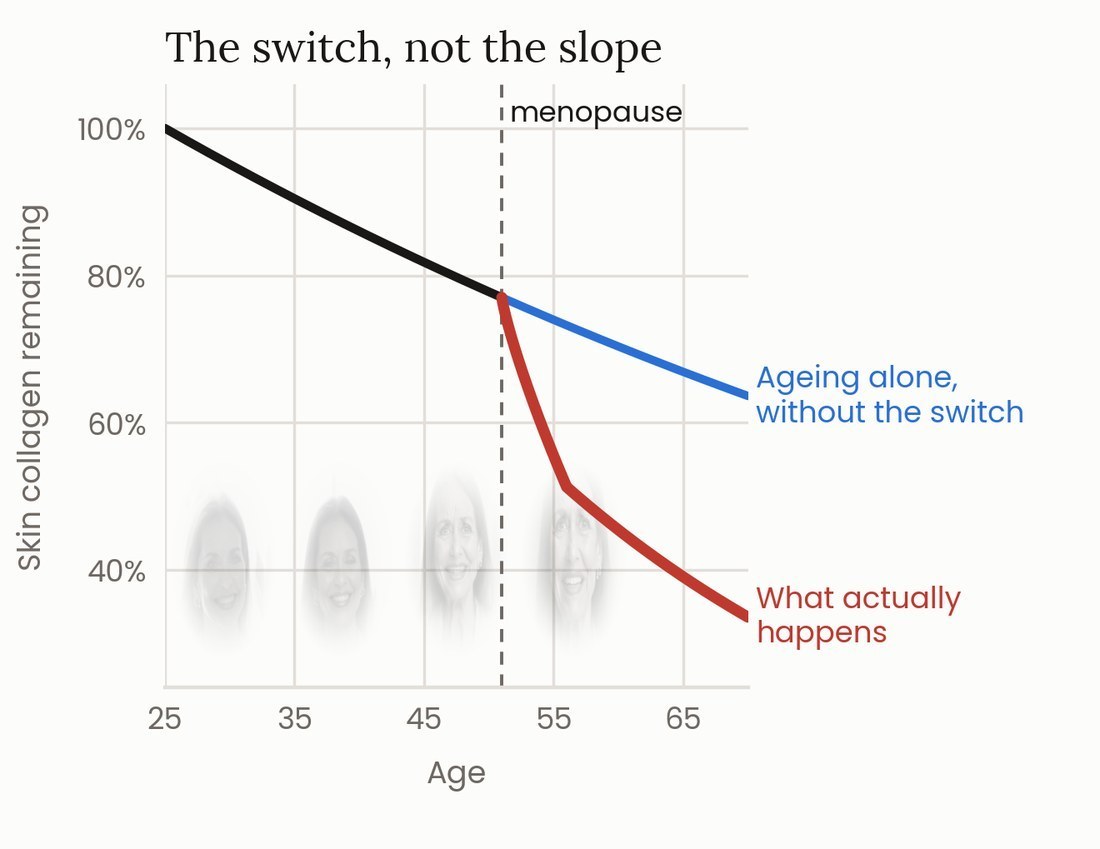
The figure everybody quotes: around 30% of skin collagen lost in the first five years after menopause, then roughly 2% a year for the next fifteen. Skin thickness falling about 1.1% a year. Ordinary chronological ageing, by comparison, runs closer to 1% a year.
Now, that figure is quoted literally everywhere, and almost always without a source.
From my own reading it traces back to small historical studies, and while it is directionally right, it is repeated a great deal more confidently than the evidence supports. The studies are longitudinal across perimenopause and menopause, over ten to fifteen years, and there is a genuine paucity of work tracking cellular and collagen change over the crucial two to five years of early perimenopause.
But there is a finding underneath the numbers that matters far more than the numbers themselves, and it almost never gets quoted.
Skin collagen tracks menopausal age, not chronological age.
Two women of fifty-two can be structurally years apart, depending entirely on where each sits in the transition.
Which means the birthday is close to irrelevant. What matters is how long it has been since the hormonal shift began — and that is why one woman sails through her forties and her friend, the same age, feels her face change in eighteen months.
Why perimenopause is the harder question
Almost everything written on this subject is about post-menopause. Perimenopause — the years leading up to it — is both harder to study and more relevant to the women I actually see.
Because in perimenopause, oestrogen is not declining smoothly. It is oscillating, sometimes to peaks higher than baseline, before dropping into troughs.
The skin is responding to volatility, not to simple deficiency.
That may well explain the erratic quality of the experience women describe and that nobody ever validates. Good weeks and bad weeks. A month where everything looks fine and then a month where it does not. Which is precisely the pattern that makes a woman doubt her own perception — and precisely the pattern you would predict from a tissue responding to a hormone that is swinging rather than falling.
As I said, the evidence base for these assumptions is thinner than I would like. Most of the hard data comes from post-menopausal groups, and perimenopause specifically is under-studied. That is a real gap, and the reason for it is obvious when you think about it.
By the time a woman in perimenopause stops second-guessing herself and sees a doctor about the face she no longer recognises in the mirror, the changes have already quietly been happening. How do you assemble a study population being hunted by a highly efficient stealth collagen assassin, when by the time the targets realise it is happening it is already too late?
The alternative is to enrol women prospectively. “We would like to measure the collagen concentration and general health of the skin of your face, and capture that data over the next five years as your face migrates to Antarctica, on the condition that you do nothing whatsoever to stop the descent. Sound cool with you?”
Sure, brah. Sign me up.
What follows from this
The honest answer is that some of this responds and some of it does not, and knowing which is which is most of the job.
The barrier, the hydration, the dullness and the reactivity are the most responsive. They are also the things women are least often told about, because they are unglamorous. That layer can change measurably within weeks to a few months, it requires no procedure of any kind, and it is the part of the picture that most reliably improves.
The structural collagen loss is a different matter. It responds, but slowly, incompletely, and with a ceiling — which is the subject of my last article and I will not repeat myself. What can be done is real. It is not restoration to a previous state, and any suggestion otherwise should be treated with suspicion.
And the bone and fat changes underneath it all do not respond to any of this. They are the foundation the rest sits on, they change on their own schedule, and no amount of anything applied to skin alters them.
Which brings me to the part that actually matters, and it follows directly from the loop.
If the scaffold fragments and the fragmentation drives further fragmentation, then the state of the scaffold when the hormonal shift arrives is not a minor detail. It is close to everything. Preserving an intact scaffold and rebuilding a fragmented one are not the same task, and they do not carry the same odds. This is not a marketing argument for doing something early. It is an unavoidable consequence of how the feedback loop works, and it happens to be the least commercially interesting thing I could tell you, because most of it costs very little.
You cannot stop the hormonal change. You can arrive at it with a better scaffold.
So here is the hopeful part, and I want to be careful not to turn it into a prescription, because the specifics belong to you and whoever looks after your skin. But the principles are not complicated, and they are not secret.
The goal, put simply, is to reach your forties holding as much collagen, hyaluronic acid, ceramide and other water-binding material as you possibly can — and to keep the enzyme that dismantles them as quiet as possible for as long as possible.
- Sunscreen is the whole ballgame, and it starts in your late teens. Not once in the morning. Reapplied across the day — three times is a reasonable habit — which in practice means finding one you can reapply over makeup without wanting to throw it across the room. The best sunscreen is the one you will actually put on your face at two in the afternoon. Find it, and then bind it to your daily life with hoops of steel. Everything else in this article is a rounding error next to this.
- Vitamin C in the morning, in a serum, with niacinamide — vitamin B3 — alongside it. Both are well studied, both are inexpensive, and neither requires anybody’s permission.
- Niacinamide again at night, usually carried in a hyaluronic acid serum, which does double duty on the water-binding side.
- And vitamin A. Somewhere in your mid to late thirties, a low-strength cosmetic retinol, introduced once or twice a week and built up slowly, because the most common mistake is starting too strong and abandoning it inside a month. Stronger prescription-strength versions exist, they are better studied than almost anything else in skincare, and they are a conversation to have with your own doctor rather than something to read about in an article.
Beyond that there are treatments — the ones your doctor or your skin therapist may suggest, aimed at building collagen concentration rather than simply covering the surface. I am not going to itemise them here, partly because the right answer differs between faces and partly because that is a longer article. What I will say is that they work best as a supplement to the four things above, not as a substitute for them. Nobody has ever treated their way out of thirty years of no sunscreen.
Which is where sun exposure stops being a lecture and becomes arithmetic.
UV is the other major driver of MMP-1. Same enzyme, same scaffold, same loop. So a woman in perimenopause in this country is running two accelerators at once — one hormonal and internal, one environmental and entirely within her control. Photoprotection in the fourth decade is not about cancer, or not only about cancer. It is about not adding a second set of scissors to a system that has already lost its brakes.
I have spent a career looking at Australian faces, and I would put it plainly. The difference between two women of the same age in the same hormonal position is more often a story about the previous thirty years of sun than about anything either of them did last year.
On hormone therapy I will be brief, because this article is not about it and I do not want it to become about it.
The observational data on skin in women taking systemic oestrogen is consistently favourable, which is unsurprising given everything above. That is not, by itself, a reason to take it. The decision turns on age, on timing, on personal and family history, and on a serious conversation with a doctor who knows you. What I would say is this. If you are having that conversation for other reasons and skin has never once been mentioned in it, that is not because skin is unaffected. It is because nobody thought it worth raising.
What I am not going to do is hand you a protocol for your own face. Not out of coyness, but because the genuinely useful question is not what to apply. It is where the loss has actually occurred in your particular face — skin, fat or bone — and that cannot be worked out from an article, or a brochure, or a photograph on a screen.
But the four things above are not that question. They are the floor, they apply to almost everybody, and the earlier you start them the less there is to fix later.
None of this is vanity
It is a measurable structural change in an organ, occurring on a known timeline, driven by a hormonal shift that also affects bone, brain, sleep and cardiovascular risk — and which happens to be the only one of those you can see in a shop window.
The women who describe it as sudden are not failing to cope, and they are not imagining it. They are reporting, with remarkable consistency, something that is genuinely happening to them faster than anybody warned them it would.
Understanding it is worth something on its own, whether or not you choose to do anything about it.
Being told you are mistaken about your own face is worth nothing at all.
The short version
The argument above, in twelve frames. Swipe or use the arrows.
Perimenopause
“I woke up and looked in the mirror and my face had fallen off.”
“My cheeks have inconveniently relocated to my jowls.”
“Overnight I developed hooded eyes and dull, floppy skin.”
“I caught myself in a shop window and suddenly realised I had become my mother.”
“I look like I feel. Sad, angry and tired.”
Thirty-five years of general practice. Thousands of women. The descriptions vary — one thing almost never does. They tell me it happened overnight.
They’re right.
It did happen fast.
Genuinely fast, on a measurable curve, and there is a physiological reason for it. Thousands of women, decades apart, using almost the same words — that is not a story about mirrors.
The part nobody mentions
Your skin is an endocrine organ.
Oestrogen receptors run right through it — on the collagen-making fibroblasts, the outer layer, the pigment cells, the oil glands, the hair follicles. That puts skin in the same category as bone. With one difference. It is the only one of them you can see.
When we talk about what menopause does to bone, nobody calls it vanity.
One switch, two arms
Oestrogen does two things to the cell that makes collagen.
- 1It increases production of new collagen
- 2It suppresses MMP-1, the enzyme that breaks collagen down
- 3Withdraw it and both arms reverse at the same moment
The shape of it
Not a slope. A switch.
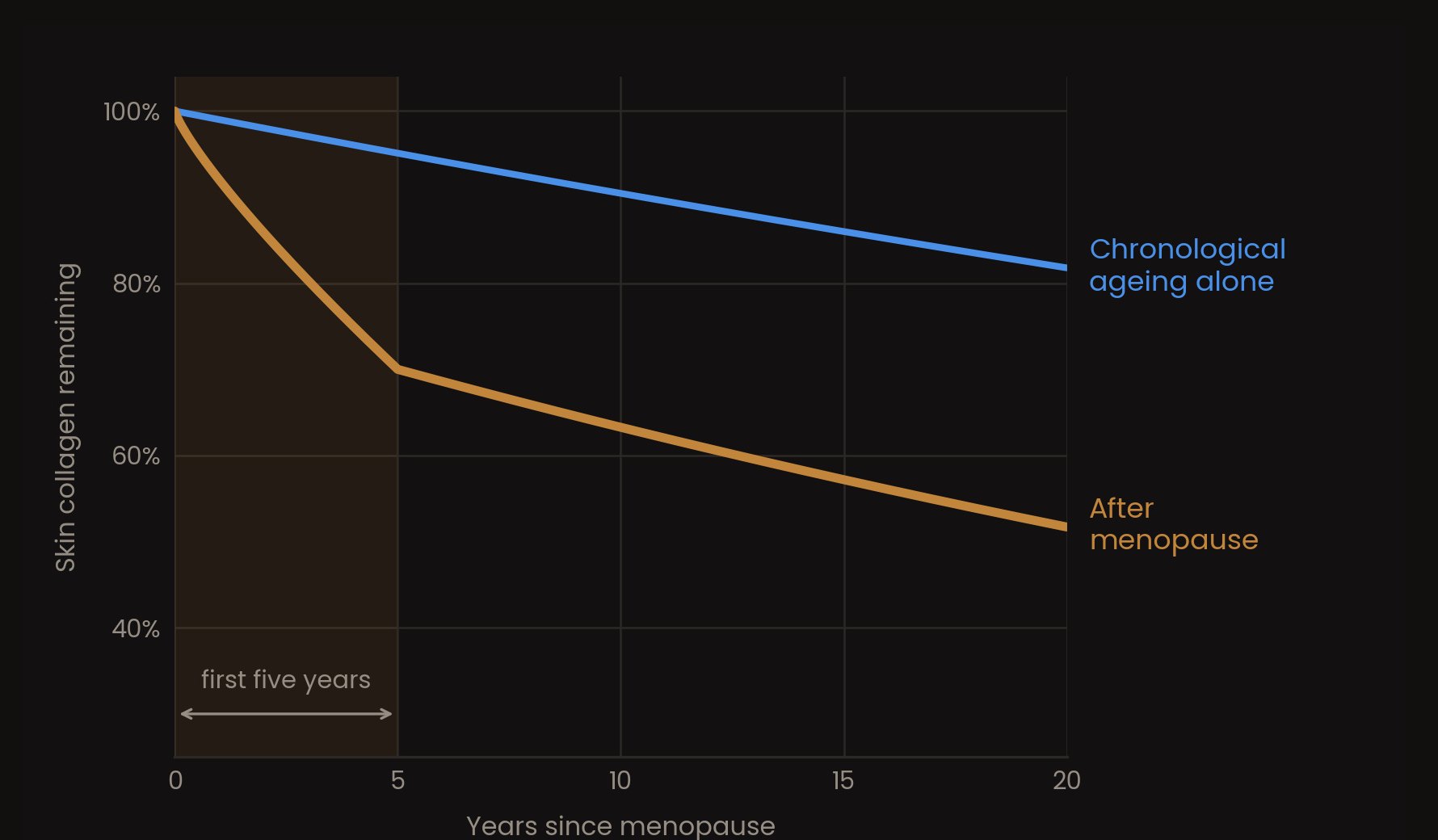
Schematic — the shape of the figures quoted in the literature, not measured data.
Around 30% of skin collagen in the first five years, then roughly 2% a year. Ordinary ageing runs closer to 1%.
Skin collagen tracks menopausal age, not chronological age.
Two women of fifty-two can be structurally years apart, depending entirely on where each sits in the transition. Which is why one sails through her forties and her friend, the same age, feels her face change in eighteen months.
Why it feels erratic
In perimenopause oestrogen does not decline. It swings.
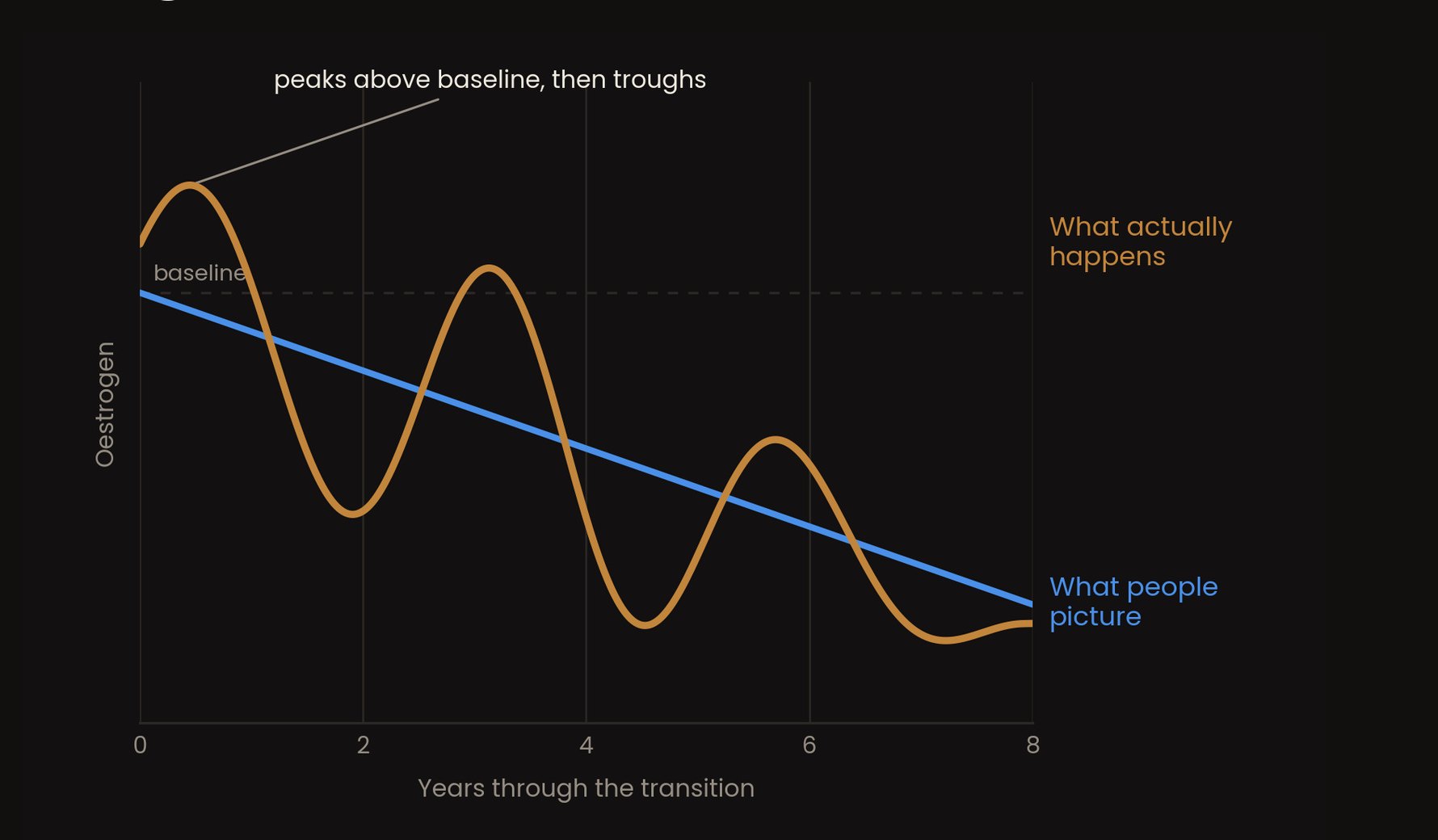
Schematic.
The skin is responding to volatility, not deficiency. Which is exactly the pattern that makes a woman doubt her own perception — good weeks, then bad weeks.
The floor, not the ceiling
Four things, and none of them require anybody’s permission.
- 1Sunscreen — reapplied across the day, not once at 7am
- 2Vitamin C in the morning, with niacinamide
- 3Niacinamide again at night, in a hyaluronic acid serum
- 4Vitamin A from your mid-to-late thirties, started low
You cannot stop the hormonal change. You can arrive at it with a better scaffold.
Preserving an intact scaffold and rebuilding a fragmented one are not the same task, and they do not carry the same odds. This is the least commercially interesting thing I could tell you, because most of it costs very little.
None of this is vanity
They are not failing to cope. They are not imagining it.
It is a measurable structural change in an organ, on a known timeline, driven by a shift that also affects bone, brain, sleep and cardiovascular risk — and which happens to be the only one of those you can see in a shop window.
Being told you are mistaken about your own face is worth nothing at all.
1 / 12
This is an educational article, not a treatment recommendation. The risks that apply to cosmetic procedures are set out on the risks and recovery page, and every option begins with an in-person consultation. Related reading: The most misused phrase in aesthetic medicine · Consultations for skin quality and hydration.